



How 3D Printing Helps a Drone Manufacturer Use NextShapes PLA CF to Accelerate Prototype Iteration and Small-Batch Production
 2026.04.21
  NextShapes,PLA CF,3D Printing
  <1 minute


The drone industry is one of the fastest-growing sectors in manufacturing today. While major players like DJI dominate the market, many small and medium-sized companies still carve out space by focusing on niche offerings. A typical example is a European mid-sized drone design company (referred to as "the company" here), which specializes in industrial inspection drones. With a team of fewer than ten people, they need to frequently complete the full process from structural validation to small-batch delivery.
To control costs and shorten development cycles, the company introduced NextShapes PLA CF, an FDM filament containing 15% carbon fiber. This material offers a combination of high stiffness, resistance to bending, toughness, and good surface finish, which effectively hides layer lines and is compatible with most FDM 3D printers on the market. Below, we will explore how they applied this material in prototyping, tooling, and functional components, showcasing the growing role of 3D printing in modern product design.

Read More >
Controlling Operational Costs and Maintaining Agile Development
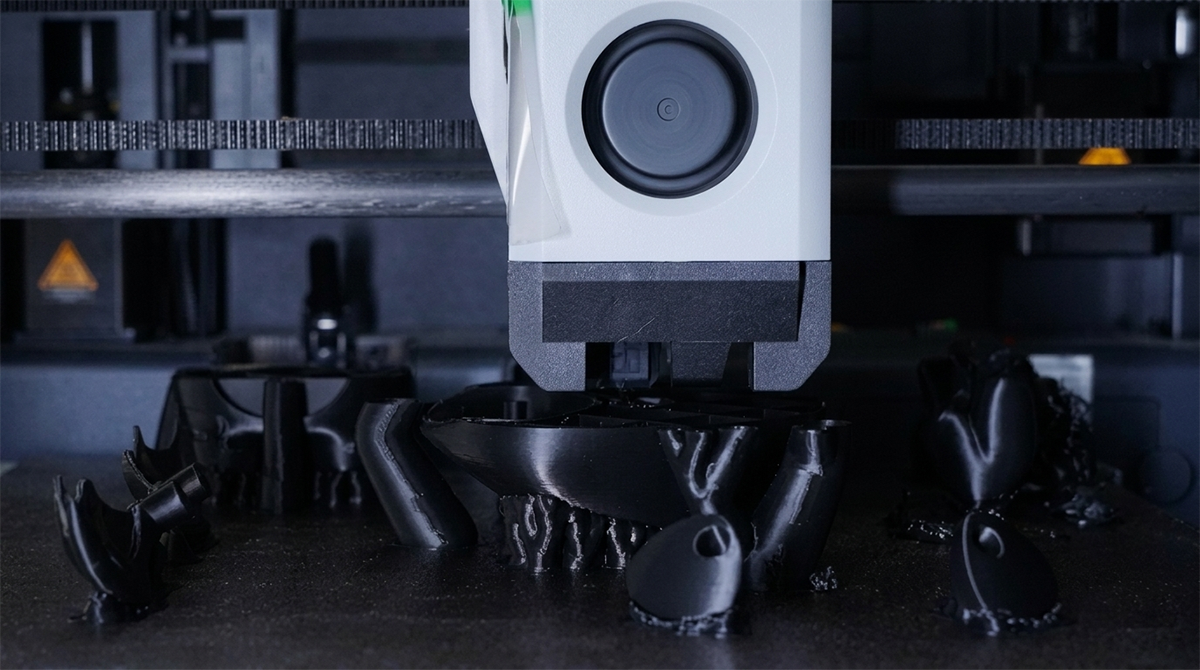
For small teams, every week saved in development time translates into faster market response. In the past, the company relied heavily on outsourced CNC or SLS 3D printing during early validation stages, which would result in iteration cycles of 5-7 days. The team leader mentioned that they had tried regular PLA or ABS, but the strength was insufficient, or warping was too severe to simulate real-world conditions.
“We needed a filament that could be printed quickly in the office, with mechanical properties close to the final product. Regular PLA was too brittle, and ABS was too difficult to 3D print. Carbon fiber-reinforced filaments were always the ideal direction, but we thought they were too expensive or difficult to 3D print with.”
After evaluating several carbon fiber filaments, they chose NextShapes PLA CF. The 15% carbon fiber content significantly improved stiffness and resistance to bending while maintaining good printability. This material can be reliably printed on most desktop FDM 3D printers without the need for an enclosed build chamber, greatly lowering the entry barrier for in-house 3D printing.
On-Demand Manufacturing of Tooling and Auxiliary Fixtures

The drone assembly process requires a variety of customized positioning fixtures, cable holders, and temporary support structures. Previously, these parts were either handmade (resulting in poor precision) or outsourced (with long lead times). After introducing NextShapes PLA CF, the team achieved an on-demand manufacturing process where design and 3D printing could be completed on the same day.
We have a custom device for testing the motor balance of the propeller, which needs a fixture that can hold the motor base without scratching the surface. The version 3D printed with regular PLA deformed after two days. After switching to PLA CF, the stiffness significantly increased, and it showed no creep even after a week of continuous use.”
Moreover, the material’s ease of assembly (thanks to the dimensional stability provided by the carbon fiber) meant that multi-part fixtures could fit together without secondary polishing. Team members even designed a vacuum suction cup connector during lunch, 3D printed it in the afternoon, and used it on the machine the following morning. This demonstrated how 3D printing for product design enables rapid iteration of manufacturing aids.
Rapid Functional Prototyping to Shorten Development Cycles

The company once received an urgent order to customize 20 sets of lightweight inspection drones for use in high-humidity coastal environments. According to the original process, it would take 3 months from structural design to functional validation, with a significant amount of time spent waiting for outsourced strength prototypes.
With NextShapes PLA CF, they were able to complete prototyping of all the key structural components in-house, including motor mounts, battery compartment clips, and gimbal brackets. Due to the material's high stiffness and resistance to bending, the prototypes could directly participate in hover and load tests, with results within 15% deviation from the final injection-molded parts.
“In the past, we could only use regular PLA for visual checks, and strength tests had to wait for CNC or SLS 3D printed parts. Now, using PLA CF, we can directly assemble and fly the drone with the same file. While this isn’t the final production material, it’s enough to catch 80% of design flaws.”
As a result, the project took only 5 weeks from design to first batch delivery—around 40% faster than usual. The team leader estimated that this single project saved about two months of external service fees, highlighting the efficiency of 3D printing for functional prototyping.
Using PLA CF to Directly Manufacture Some End-Use Parts
For small batches (10-30 sets) of custom drones, it is not economical to open injection molds. The company began using NextShapes PLA CF for non-safety-critical end-use parts, such as antenna mounts, canopy hinges, and internal cable holders. These components don't need to withstand extreme impacts but do require stiffness, weather resistance, and assembly accuracy.
“In an order for a coastal inspection drone, the customer requested that the plastic parts of the fuselage have a certain level of salt spray resistance and not be too brittle. We delivered PLA CF 3D printed battery covers and sensor mounts. After three months of field use, we received no feedback on cracking or deformation.”

In addition, the material's ability to hide layer lines gave the parts a matte black finish, which required no post-processing to meet typical industrial appearance requirements. The team even used the material to repair parts of an old agricultural drone—original parts were no longer in production, so they scanned and modeled the components and 3D printed replacements directly.
“We don’t see PLA CF as the end material for final products, but it offers stiffness and surface quality close to engineering plastics on an FDM 3D printer. It has completely changed our perception of 3D printing. For small teams, this is the most practical productivity tool, especially for 3D printing for product design and rapid prototyping.”