



NextShapes 405 nm LCD/DLP 3D Printing Material: Elastic Enables Flexible, Durable Part Production
 2026.03.25
  NextShapes,Elastic ,3D Printing
  <1 minute


The NextShapes materials library continues to expand, offering engineers and product developers new possibilities for producing flexible, high-performance parts through 3D printing. Elastic, introduced by NextShapes, is a black flexible material designed specifically for 405 nm LCD/DLP 3D printers, ideal for creating rubber-like, tear-resistant, and mechanically robust functional components via 3D print technology.
Elastic is an important addition to the NextShapes photopolymer 3d resin lineup, contributing to a growing materials ecosystem that enables low-cost, scalable additive manufacturing. As a versatile 3d resin, it provides a practical alternative to traditionally outsourced silicone, polyurethane, and rubber parts, supporting faster design iteration and greater production independence through in-house 3D printing.
Combining rubber-like elasticity with the toughness and tear resistance required for functional use, Elastic is well-suited for applications involving repeated bending, pressing, or compression without failure. Users can integrate Elastic into their 3D printing workflows to develop prototypes, consumer products, or end-use parts that require long-lasting rubber-like properties. Whether for prototyping or production, this 3d resin delivers consistent results across 3D printers.

Elastic Applications
In automotive and industrial 3D print applications, custom seals, gaskets, and damping components are often produced in small batches for prototyping or testing fixtures. Traditionally made using silicone molding or polyurethane casting, these parts involve long lead times, high tooling costs, and limited design flexibility. With Elastic, manufacturers can produce functional, weather-resistant seals and bushings directly from digital files using 3D printing, enabling rapid iteration and reducing reliance on external suppliers. This approach to industrial 3D printing transforms how custom components are sourced.
For companies developing consumer electronics or wearable devices, components such as ergonomic grips, soft-touch surfaces, and protective enclosures require both comfort and durability. Elastic allows designers to integrate flexible features directly into parts without overmolding or multi-material tooling. For example, one electronics manufacturer used Elastic to create fully functional protective frames for handheld devices, quickly validating fit, feel, and impact resistance in a fraction of the time required for traditional molded samples—all through 3D printed prototypes that accurately represent final material properties.
In industrial tooling and manufacturing aids, applications such as soft jaws for CNC machining, vacuum forming molds with flexible edges, and press-fit components benefit from Elastic's tear resistance and fatigue life. These parts are traditionally machined from polyurethane or rubber, which can be costly and time-consuming for custom or low-volume configurations. Direct 3D printing with Elastic simplifies workflows, shortens lead times, and improves operational efficiency. As a result, more manufacturers are turning to industrial 3D print solutions for their tooling needs.
High-Performance, Multi-Functional Material
Each material in the NextShapes 405 nm LCD/DLP ecosystem is engineered to address specific challenges. Compared to standard and other flexible resins, Elastic stands out with superior elongation at break and tear strength, making it ideal for parts subjected to repeated deformation. This 3d resin is formulated to perform reliably on a wide range of 3D printers.
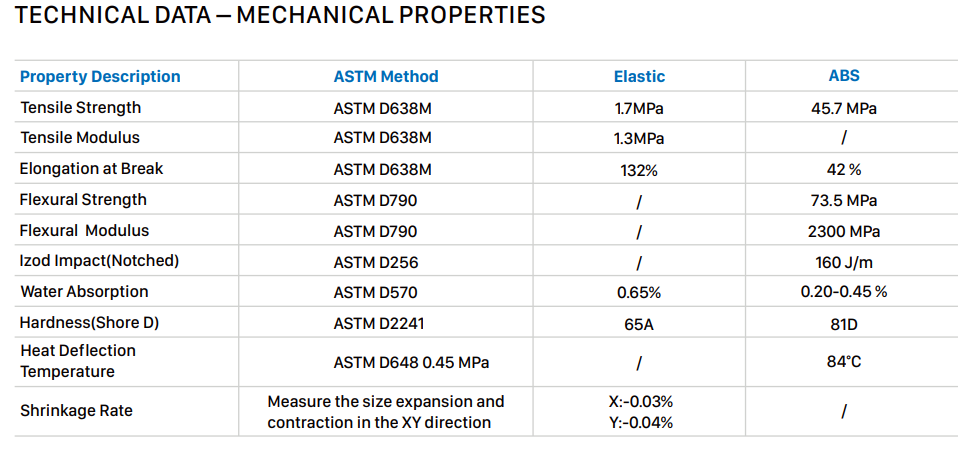
Traditional flexible materials may suffer from permanent deformation or cracking under cyclic loading, whereas Elastic maintains its shape and mechanical integrity even after hundreds or thousands of bending cycles. Its optimized hardness closely mimics TPU and rubber, providing realistic tactile feedback for functional prototypes and end-use parts produced via 3D printing.
In addition to mechanical toughness, Elastic offers excellent interlayer adhesion and consistent print performance across various 405 nm LCD and DLP 3D printers. Parts 3D printed with Elastic resist delamination in applications such as hinges, straps, and press-fit interfaces, ensuring reliability. The 3D printed components exhibit durability that rivals traditionally manufactured elastomeric parts.
Cost-Effective Workflow and Simplified Post-Processing
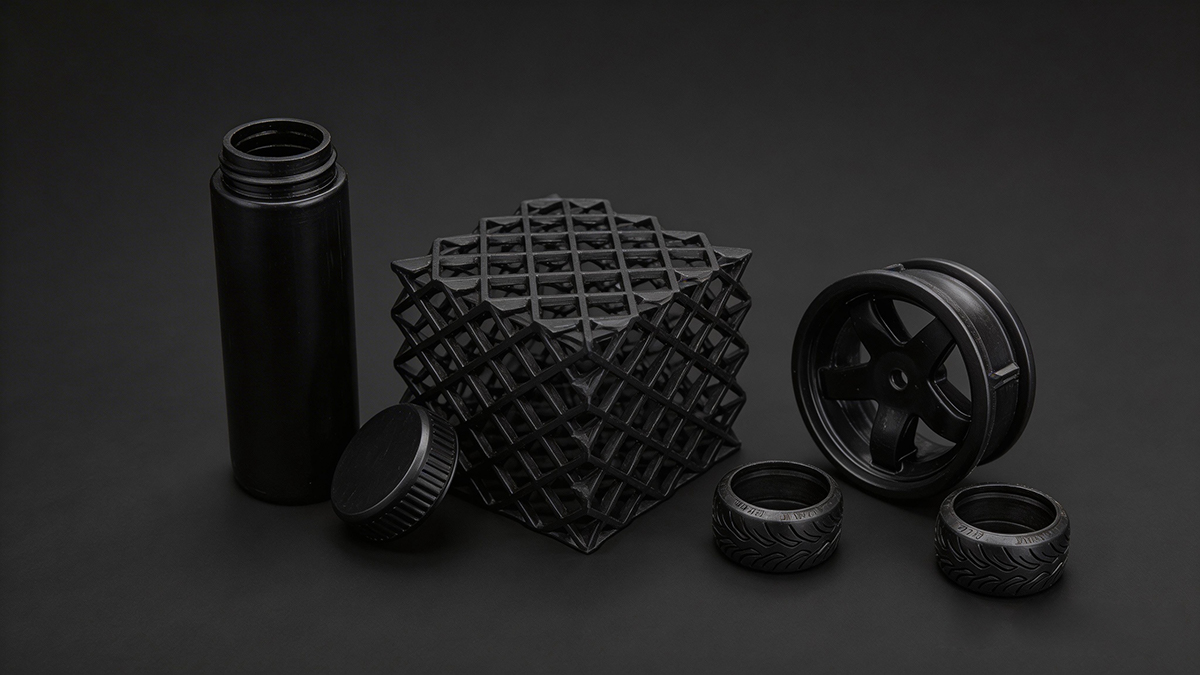
Elastic is formulated for ease of use on standard 405 nm LCD and DLP 3D printers, requiring no special hardware or complex handling. This 3d resin can be printed on most consumer and professional platforms using standard settings, with recommended layer thickness and exposure parameters provided for consistent results. Getting started with 3D printing Elastic is straightforward and accessible.
Post-processing is straightforward: 3D printed parts are washed in isopropyl alcohol or a compatible solvent, then UV-cured to achieve final mechanical properties. Unlike some flexible materials that are fragile during support removal, Elastic offers sufficient green strength for clean support removal with minimal risk of damage. This makes 3D printing with Elastic a practical choice for both prototyping and low-volume production. Its black pigmentation ensures a consistent appearance, often eliminating the need for secondary finishing.
For users managing multiple materials on the same machine, switching between Elastic and standard 3d resins requires only routine cleaning of the resin tank and build platform, minimizing downtime and maximizing flexibility. Whether using 3D printers for functional parts or visual models, material changeover remains efficient.
Enhancing Production Flexibility with Elastic

Historically, elastomer-like additive manufacturing materials were limited to expensive industrial 3D print systems or proprietary ecosystems. Producing truly elastic parts often requires outsourcing to silicone or polyurethane molding services, adding weeks to development cycles and limiting design agility. Today, 3D printing has changed that paradigm.
With NextShapes Elastic, engineers and developers can bring flexible part production in-house using widely available 405 nm LCD and DLP 3D printers. By combining high tear resistance, fatigue durability, and realistic rubber-like surface properties, Elastic expands the range of applications achievable with desktop 3D printing. This 3d resin empowers users to achieve industrial 3D print quality on accessible platforms.
Whether creating functional prototypes for user testing, custom tooling capable of withstanding repeated mechanical stress, or end-use consumer products with integrated flexible features, Elastic provides greater control over the manufacturing process. As a key addition to the NextShapes material library, it broadens the boundaries of in-house production—helping more projects move from design to finished product faster and with greater confidence through 3D printing. From concept to 3D printed part, Elastic delivers performance and reliability.